Six Blocks, One Hour, No Zoom: A Photo Walk for Anyone Who Thinks They've Seen It All
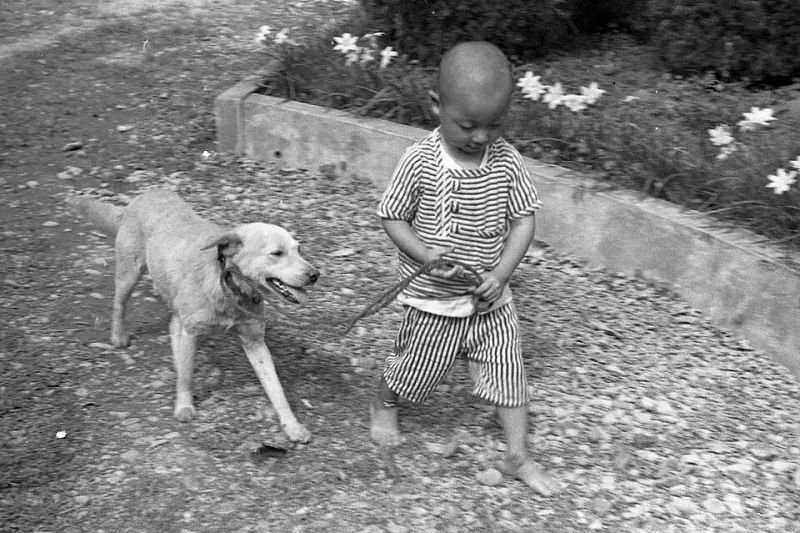
Photo: 鄧南光, Public domain, via Wikimedia Commons
The best photo walk I ever took covered about six blocks and never left my zip code. I passed the same laundromat I had driven by four hundred times, and for the first time I noticed that the dryers throw a soft amber glow at 4 p.m. that makes everyone inside look like a portrait from 1974.
That is the whole promise of the six-block photo walk. Small radius, no escape hatch, one hour. Constraints do not limit your eye. They sharpen it.
The Rules, All Four of Them
Pick six blocks. Not a neighborhood, not a county. A cluster of streets you could walk in a slow loop in about thirty minutes. If you can drive to something more interesting, you are too far from home. The point is familiarity bordering on boredom.
Leave the zoom alone. Set your lens (or your phone) to its normal field of view and keep it there. No cropping by foot-chasing either — you can step toward something, but you cannot reach for a new angle with a flick of two fingers. Fixed focal length is the oldest and most effective teacher in photography.
Shoot for one hour. Set a timer. The first fifteen minutes will feel like a waste. That is normal and it is part of the process. Somewhere around minute forty, the ordinary starts resolving into specifics.
Delete nothing. Not in the field. Not that night. You are allowed to be bad at this for an hour. Reviewing while shooting means judging while seeing, and those two activities refuse to happen at the same time.
One more thing: no airpods. The walk is a seeing exercise, and half of seeing is hearing where to point the camera.
Prompts to Carry With You
You do not need a formal assignment, but a shortlist helps when you freeze up. Pick three before you leave and try to complete them in the hour.
- One doorway, three ways. Same door, three different distances, times, or light conditions.
- Somebody working. Anyone mid-task — sweeping, stocking, texting on a break, wrestling a stroller. Hands are the assignment.
- Light on a wall. Find the one surface in your six blocks that does something interesting between 3 and 5 p.m.
- A thing that was not built to be looked at. A utility box, a drain, a fence patch, a curb someone painted.
- Two people who are not posing. A conversation at a bus stop. A kid being scolded gently. Shoot from a respectful distance, and if you are close enough to be noticed, be a decent human about it.
- The edge of the frame. Compose your subject dead center, then compose it pressed against the left edge. Notice what the emptiness does.
- One frame at eye level, one from the ground. Kneel. It is the cheapest new perspective available to you and it works every single time.
It Works in Every Kind of Town
In a dense city, six blocks is a whole ecosystem — stoops, delivery bikes, bodega awnings, a crosswalk that fills and empties like a tide. The instinct is to shoot wide and busy. Fight it. Get closer than feels polite and let one person or one object hold the whole frame.
In the suburbs, six blocks is quieter and that is the advantage. Lawns, mailboxes, garage doors, basketball hoops that have not moved in a decade. Look for repetition with one thing out of place — the lone tricycle in a driveway of leaves. Suburban photography fails when it tries to look urban. Let it be still.
In a small town with one stoplight, you have something a city photographer cannot buy: continuity. Shoot the same six blocks in November, February, and May. The change becomes the story. That is how a body of work gets made without ever traveling.
What One Hour Actually Does
Most of us shoot the way we shop — quick, distracted, hunting for something worth the effort. A fixed hour in a fixed place flips that. Once you accept that nothing novel is going to appear, your attention has nowhere to go but deeper into what is already there.
You will come home with maybe forty frames and three you genuinely like. The three will surprise you. They will be the ones nobody else on earth could have taken, because nobody else was standing on that sidewalk at 4:15 on a Tuesday being patient about a laundromat.
The familiar is only generic if you look at it the way everyone else does. Sixty minutes, six blocks, no zoom. That is the entire technique — and in a country that keeps telling you the good pictures are somewhere else, it might be the most useful hour you spend all week.