One Photographer, No Audience: How Being Alone Changes Everything You Shoot
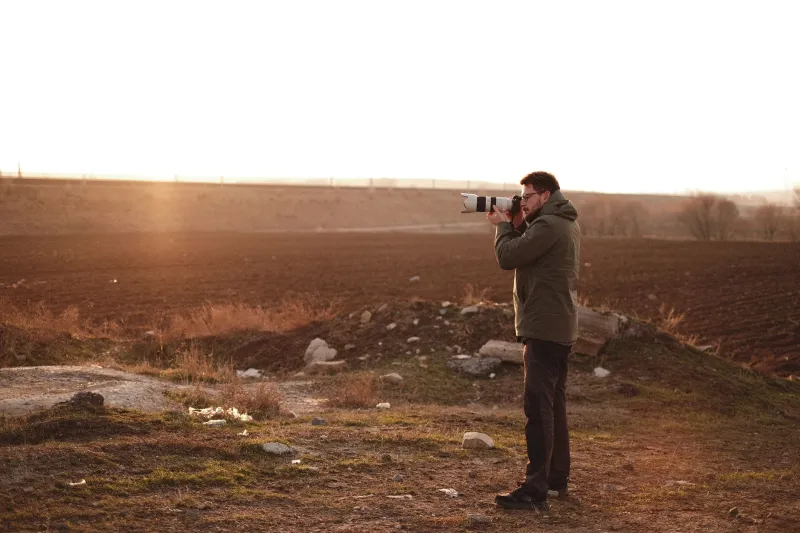
Ask any photographer to describe the difference between shooting alone and shooting with someone else, and watch their face shift. It's not a technical question. It touches something more personal — something about who you become when the camera is the only thing watching.
The images that come out of those two situations aren't just stylistically different. They're philosophically different. And understanding why might be the most useful thing you do for your photography this year.
The Solo Photographer's Particular Kind of Freedom
When you're alone with a camera, something settles. There's no one to consult, no shared vision to negotiate, no subtle pressure to perform competence for a collaborator. It's just you, the light, and whatever's in front of you.
For travel photographer Dana Osei, who spent three months documenting small-town diners across the American South on her own, solo work felt like a different mode of consciousness entirely.
"When I shoot with someone else, I'm always half-aware of them," she says. "Even when they're not saying anything, there's a version of me that's narrating what I'm doing, justifying my choices. Alone, that voice goes quiet. I stop explaining myself and I just... look."
That quiet tends to produce a particular kind of image. Slower. More patient. More willing to sit with something unremarkable until it becomes remarkable.
Solo work also changes your relationship with time. There's no one waiting on you. You can stand in one spot for forty minutes if that's what the light requires. You can double back. You can decide the whole day was wrong and start over. That freedom is genuinely hard to replicate when someone else's schedule is in the mix.
What Gets Lost When Nobody Else Is There
But solo shooting has a blind spot that's easy to miss until you're deep in an edit, staring at a folder full of images that all feel like they came from the same emotional temperature.
You only see what you see.
Family photographer Marcus Delgado, based in Austin, Texas, has shot both documentary family sessions and solo street work for over a decade. He's noticed that his solo images, while often technically stronger, can feel sealed off in a way his collaborative work doesn't.
"When I'm working with a family, the other parent is always catching something I missed," he says. "Someone will tap my arm and go, 'did you see that?' And I'll turn around and there's this incredible moment happening three feet away that I was completely blind to because I was focused somewhere else."
Two sets of eyes don't just double the coverage. They create a different kind of attention — one that's less singular and more ambient. The frame becomes porous in a way it can't be when you're the only one watching.
There's also the matter of what subjects do when they know only one person is watching versus a team. Marcus puts it simply: "Families relax differently when I bring an assistant. Suddenly it feels more like a thing that's happening, less like they're being studied. They start performing for each other instead of for me."
The Collaborative Frame: Shared Vision or Compromise?
Shooting with a partner — whether that's a second photographer, a videographer, or even just a friend with their own camera — introduces something that solo work can never replicate: negotiation.
And negotiation, it turns out, can be generative.
When documentary filmmakers Priya and Sam Whitfield started collaborating on a long-form visual project about first-generation college students across the Midwest, they quickly discovered that their disagreements were producing their best work.
"Priya would want to stay in a classroom and wait for something to happen," Sam says. "I'd want to follow someone into the hallway. We'd argue about it for a minute, and then one of us would be right — but sometimes we'd both go, and we'd end up with two completely different but equally true versions of the same afternoon."
Shared shooting doesn't just capture more moments. It captures more interpretations of the same moments. That multiplicity can make a final body of work feel richer, more dimensional — like it was seen rather than surveilled.
The challenge, of course, is when shared vision becomes averaged vision. When both photographers defer to each other so consistently that the work loses any strong point of view at all. The best collaborative photography requires both people to hold their perspective firmly while staying genuinely open to the other's.
When You're Not the One Holding the Camera
There's a third situation worth naming — one that doesn't get discussed nearly enough: being photographed by someone who knows you.
The images that come out of that particular dynamic are unlike anything either solo or collaborative professional work produces. There's an intimacy in being seen by someone who loves you, or knows you, or has history with you — and a camera held by that person captures something qualitatively different from what a stranger's lens would find.
Some of life's most genuine photographic moments only emerge in exactly this scenario. The candid your partner took when you didn't know they were watching. The photo your best friend grabbed at the end of a long road trip when everyone was tired and real. The one your kid took of you laughing at something they said.
Those images are rarely technically perfect. They're almost never composed with intention. But they hold a kind of truth that's very hard to manufacture — because the subject wasn't performing for the camera. They were just being themselves in front of someone safe.
Finding Your Mode
Neither solo nor collaborative shooting is superior. They're different instruments, and the best photographers learn to move fluidly between them depending on what the work requires.
If you've been shooting mostly alone, consider inviting someone along — not to take over, but to watch alongside you. Let their attention teach you something about where yours goes.
If you've been mostly shooting with others, carve out a session by yourself. Let the quiet settle. See what your eye does when there's no one to explain it to.
The camera, as always, will show you exactly what was there. The interesting question is who was watching — and what that changed.