That One Photo You Can't Stop Opening: The Science of Images That Stay With You
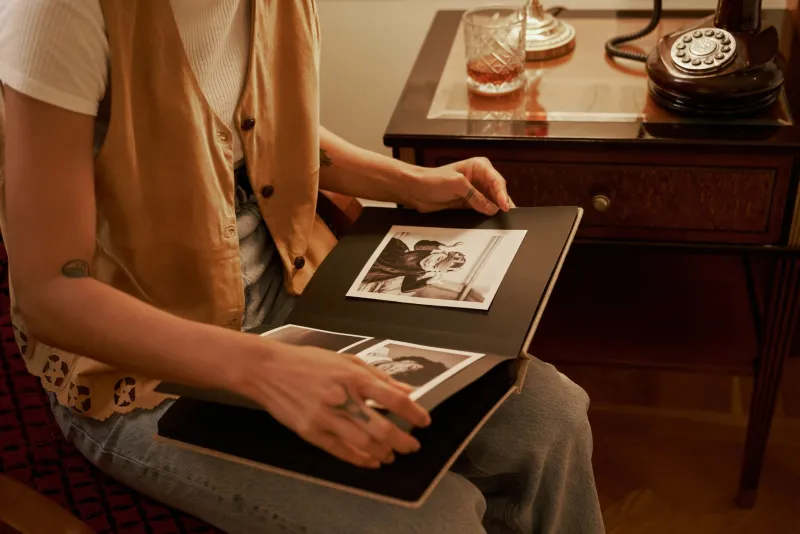
You've scrolled past it a hundred times and still stopped. You've shown it to people who smiled politely without really seeing what you see. You've zoomed in on a corner of it — the way the light lands on someone's shoulder, the blurry figure in the background, the expression that's almost a smile but not quite — and you've thought: what is it about this one?
Every serious photographer and every casual phone snapper has at least one of these. A return photo. The frame you orbit back to.
It's not always the best photo you've ever taken. Sometimes it's technically imperfect — soft focus, weird crop, a little blown out. But something about it refuses to release you. Understanding why might be one of the most honest things you can do as someone who loves images.
The Feeling Has a Name (Sort Of)
Psychologists who study autobiographical memory talk about something called reminiscence bumps — the way certain periods of our lives feel more emotionally vivid than others, and how the artifacts from those periods carry disproportionate weight. Photos from those windows of time don't just represent a moment. They become a kind of emotional shorthand for a whole era of who you were.
But the return photo isn't always from a big moment. Sometimes it's from a Tuesday. A Sunday morning. A nothing-special afternoon that somehow got captured in exactly the right way.
That's where composition sneaks in. Research in visual perception suggests that certain image structures — leading lines that pull your eye inward, off-center subjects that create a sense of motion or longing, warm tones that trigger physiological calm — activate the brain's reward circuitry in ways that feel almost involuntary. You're not just choosing to look again. Part of you is being pulled.
What Readers Say About Their "Return Photos"
We asked the Simply Be Photo community to tell us about the image they come back to most. The responses were striking not for their variety, but for their similarity.
Denise from Tucson described a photo her daughter took by accident — she'd handed a seven-year-old her phone, and the kid captured a blurry, tilted shot of Denise laughing at something just outside the frame. "I don't even remember what was funny," she wrote. "But I look at that photo and I feel exactly how that day felt. Not what happened. Just how it felt." That distinction — emotional texture over factual content — came up again and again.
Marcus from Atlanta keeps coming back to a photo of his late father sitting on a back porch, reading a newspaper, completely unaware of the camera. "He's not looking at me. He's just there. And I think that's why I can't stop looking at it — I got him when he wasn't performing anything for anyone."
And then there's Priya from Seattle, who returns repeatedly to a photo she almost deleted: herself, post-breakup, sitting alone at a diner counter with a cup of coffee. A friend took it without asking. "I looked terrible. I was clearly sad. But I also look so... present. Like I was actually living through something instead of around it. I find that version of myself really brave now."
The common thread isn't joy. It isn't even beauty in the traditional sense. It's authenticity caught off guard.
Unresolved Feelings Make the Best Anchor
Here's something that might feel a little uncomfortable: the photos we return to most are often tied to emotions we haven't fully processed. Not necessarily trauma — sometimes just ambiguity. A relationship that ended strangely. A version of yourself you're not sure how to feel about. A moment that meant more than you understood at the time.
The image becomes a place where that unfinished emotional business lives. And we go back because we're still, quietly, working on it.
This is actually one of the most beautiful things photography does. It holds things for you. A photo doesn't demand resolution. It just waits. And each time you return to it, you bring a slightly different version of yourself — one that might finally be ready to see something new.
That's not haunting in a scary sense. It's haunting the way a great song haunts you. The way a line from a book you read ten years ago suddenly surfaces when you need it.
The Visual Details You Keep Zooming Into
There's another layer worth examining: the physical act of zooming in. When you find yourself pinching into a corner of an image — studying a hand, a shadow, a face in the background — you're doing something that goes beyond nostalgia. You're investigating.
Our brains are extraordinarily good at detecting that something is present in an image even before we consciously identify what it is. A fleeting expression. A detail that doesn't quite fit. The sense that something happened just outside the frame. Zooming in is often the conscious mind catching up to what the instinctive mind already noticed.
This is why minimalist, uncluttered photographs often have more staying power than busy, over-edited ones. When there's less visual noise, the meaningful details have room to breathe — and to be found, slowly, over multiple returns.
How to Recognize Your Own Return Photo Before It Becomes One
Here's the thing about return photos: you usually can't manufacture them. They tend to arrive when you've stopped trying to get the perfect shot and started just paying attention.
But you can create conditions where they're more likely to happen. Slow down before you click. Give people a moment to forget the camera is there. Shoot in natural light whenever you can — it's more forgiving of imperfection and more emotionally resonant than anything artificial. And resist the urge to immediately review and delete. Let images breathe for a week before you decide what they're worth.
The photo you keep coming back to probably didn't feel significant when you took it. That's almost the whole point. It snuck past your critical eye and went straight to somewhere deeper.
And now it lives there — patient, quiet, and entirely unwilling to let you forget whatever it is you're still figuring out.
Maybe that's not something to solve. Maybe that's just something to appreciate: the rare image that knows you better than you know it.