Nobody Asked That Person to Be There — And Yet Here We Are, Staring at Them
Look closely at your favorite photos. Not the carefully staged ones — the real ones, the ones with actual life in them. Somewhere in the background of more than a few, there's probably a stranger.
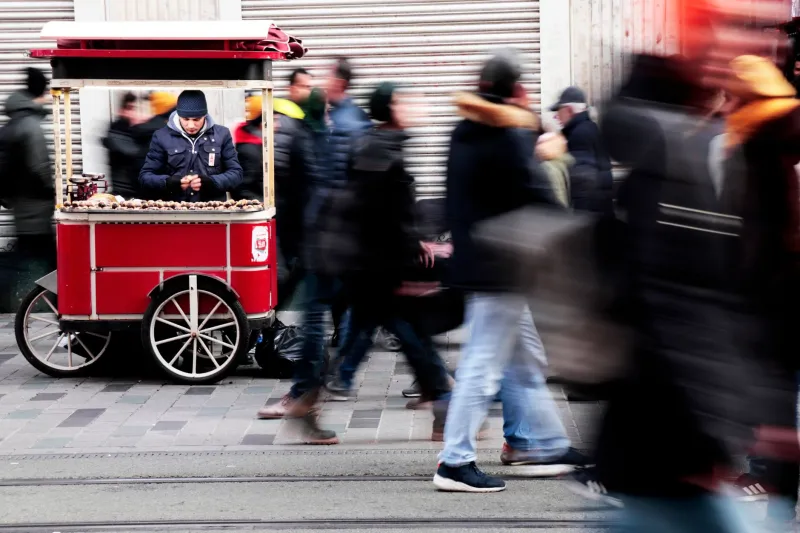
Maybe they're walking past, caught mid-step in a blur of motion. Maybe they're sitting at the table behind your family at that restaurant in Chicago, leaning into a conversation you'll never hear. Maybe they're just a pair of legs at the edge of the frame, cropped just enough to be mysterious.
You didn't put them there. You probably didn't even notice them when you took the shot. But now, years later, you keep looking at them.
Why?
The Uninvited Guest Who Completes the Room
There's a concept in visual art called negative space — the areas of an image that aren't the main subject but that give the subject meaning, context, and weight. Background strangers function a little like living negative space. They weren't the point. But they make the point land harder.
When a photo contains only its intended subjects, it can feel sealed. Complete, yes, but also closed — like a stage set after the actors have left. The moment a stranger enters the frame, something opens up. The image suddenly belongs to a larger world. It suggests that life was happening in all directions, not just in the direction of the lens.
That suggestion of a wider world is part of what makes us linger.
Katherine from Boston described a photo from her wedding day — a shot of her and her husband on the steps of a brownstone, just after the ceremony. In the background, barely in focus, an older man is walking a dog, looking up at them with an expression she can only describe as gentle. "He looks like he's remembering something," she said. "I have no idea who he is. But I've spent more time thinking about him than about half the guests who were actually there."
That wondering is the thing. The stranger invites a kind of imaginative participation that the intended subjects — whose stories we already know — simply can't.
What We Project Onto People We'll Never Meet
Human beings are relentlessly narrative. We can't look at a face, even a blurred one in the corner of a photograph, without beginning to construct a story. Who is this person? Where were they going? What were they thinking about? Did they notice the photographer? Did they ever wonder if they ended up in someone's frame?
This impulse is so strong that the less information we have, the more compelling the figure becomes. A clearly identifiable stranger is interesting. A blurred, half-visible one is magnetic. The ambiguity is the invitation.
Photographers have understood this intuitively for as long as the medium has existed. Some of the most iconic street photographs of the twentieth century derive their power from the relationship between a sharp foreground subject and an indistinct, ghostly figure somewhere behind them. The blur doesn't diminish the image. It deepens it.
In our own personal photography, that same dynamic plays out without anyone planning it.
The Accidental Witness
There's another dimension to background strangers that doesn't get talked about enough: they function as witnesses.
When you look at a photo of a significant moment — a graduation, a first apartment, a last day somewhere — and there's a stranger in the background, that stranger was actually there. They were present for a moment that mattered to you, even if they had no idea. In some quiet, strange way, your story touched the edge of theirs.
James from New Orleans has a photo from the night his father was discharged from the hospital after a serious illness. The family is standing in the parking lot, hugging, visibly relieved. Behind them, a nurse is walking toward her car, head down, clearly exhausted after a long shift.
"She doesn't know she's in the photo," James said. "She doesn't know what that night meant to us. But she was there. She was part of it. And every time I look at that picture, I think about all the nights like that she's been part of — all the families in parking lots she's walked past without knowing she was in their story."
That's not just a background stranger. That's a whole meditation on how human lives intersect without our awareness.
When the Stranger Becomes the Photo
Sometimes the accidental figure doesn't just enrich the image — they become it. The intended subject recedes, and the unexpected person steps forward.
This happens most often when the stranger's body language, expression, or position creates an unplanned visual or emotional counterpoint to the main subject. A joyful foreground subject and a pensive background stranger. A formal moment interrupted by someone laughing at something off-frame. A child in focus and an elderly person slightly blurred, both caught in the same gesture without knowing it.
These accidents can't be staged. They can barely be anticipated. They're the result of the world being more interesting than any single photographer's intention — and they're proof that the best photography is always partly a collaboration with chance.
At Simply Be Photo, we talk a lot about authentic moments and pure light. The accidental stranger is the most authentic element you can find in an image, precisely because nobody arranged it. The world just showed up and offered something true.
The Ethics of the Uninvited Frame
It's worth pausing here to acknowledge the other side of this. In public spaces across the US, street photography and incidental background appearances are generally legal. But legality and ethics aren't always the same conversation.
Most of the time, a blurred figure in the background of your family photo isn't a meaningful privacy concern. But if you're sharing images publicly — especially ones where a background stranger is clearly identifiable and the context could be sensitive — it's worth a moment of consideration. The same curiosity and humanity we extend to these figures imaginatively, we can extend practically.
In most cases, the background stranger would probably be charmed to know they ended up in someone's treasured memory. But it costs nothing to think about it.
The Person Walking Past Your Story
Here's what the accidental stranger ultimately reminds us: your life, and the photographs you take of it, exist inside a much larger world that doesn't pause for your camera.
That's not a small thing. It's actually kind of beautiful.
Somewhere out there, you're probably in someone else's background. Blurred, mid-step, thinking about what to have for dinner, completely unaware that you've become part of a story that will be looked at and wondered about for years.
And somewhere in your own camera roll, a stranger is waiting to be noticed — patient, unhurried, carrying a mystery you'll probably never solve.
Maybe you don't need to. Maybe the wondering is enough.